
Why Satisfaction Isn’t The Whole Story
Most museums ask visitors some version of the same question at the end of a visit: Did you enjoy your visit?
It’s an important question, and there's good reason the sector has tracked and relied on satisfaction so consistently over the years. Satisfaction ratings (often in the form of Net Promoter Score or “NPS”) help us understand whether exhibitions, programs, and visitor services are meeting expectations and can help shed light on where improvements might be needed.
But there's another question that's becoming increasingly important, particularly in the context of nurturing loyal, meaningful relationships with visitors: Will this person come back?
Those two questions are more different than you’d think.
We've all had experiences we really enjoyed but never repeated such as a wonderful holiday destination, a fun restaurant while visiting a new city, or an interesting museum exhibition. Enjoyment, on its own, doesn't always create an ongoing relationship.
We see this every day in the museum sector: visitors leave enthusiastic and complete surveys with glowing comments and high satisfaction scores, and some even leave a positive review on Google or TripAdvisor. Some go on to become members, donors, and advocates. Others simply move on.
So, if satisfaction can't fully explain that difference between visitors who do or don’t return, is there anything that can?
Our research points to emotional connection as the missing link to building audience loyalty.
Emotional connection is what happens when a museum becomes more than somewhere people visit. When your museum becomes part of how visitors and members see themselves and the life they're trying to create, a switch happens. It's the difference between appreciating an organization and feeling that an organization is genuinely relevant to your life.
This distinction matters because emotionally connected audiences behave differently.
In our latest research, the National Predictive Motivations® Study of art museum visitors, members, and donors, we’ve found that emotional connection predicts substantially higher repeat visitation and a much stronger likelihood of becoming a member. Our research indicates that existing members who feel emotionally connected are also more likely to renew, upgrade their membership, and make additional donations over time. We also know that emotionally connected visitors bring a higher lifetime value to the organization, which can be quantified through our Emotional Connection Score® analysis.
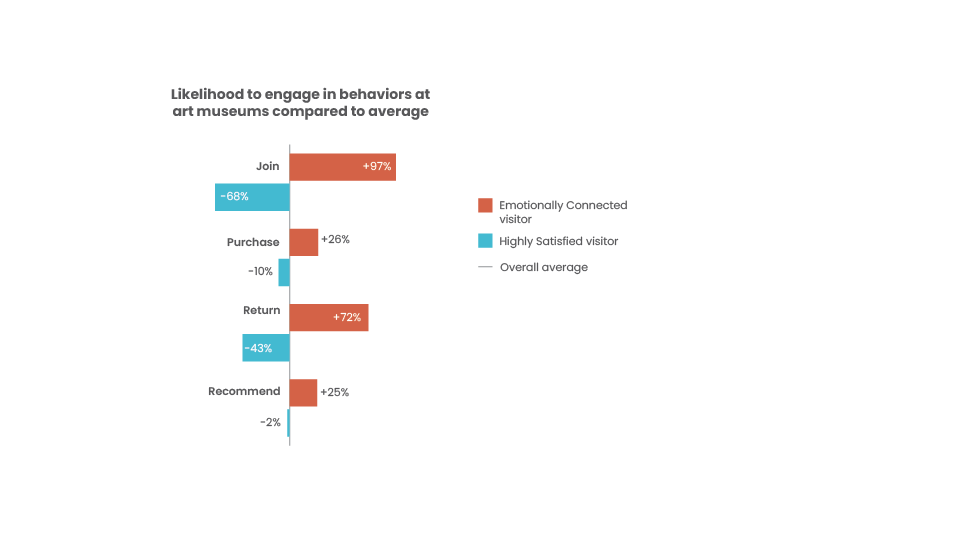
This graph shows how much more likely Emotionally Connected visitors are to join, make a purchase, return or recommend an art museum, compared to the overall average.
Simply put: Emotional connection doesn't simply tell us how people feel. It helps explain what they're likely to do next.
While satisfaction scores are still useful in understanding whether or not museums are delivering experiences that meet or exceed expectations. Let’s broaden the conversation to ask what we could be offering to build more meaningful relationships with our visitors, members, and donors.
This shift has practical implications across your organization. Marketing teams might think differently about the stories they tell. Membership teams might look beyond transactional benefits to consider how membership supports people's aspirations. Education teams might explore opportunities for building emotional connection.
From our research, we now know the exact mix of motivations that spark this emotional connection in visitors, members, and donors.
For museums navigating changing audience expectations, growing competition for people's time, and ongoing pressure to build more sustainable revenue streams, understanding emotional connection offers something particularly valuable: It provides a way to think about audiences not simply as visitors moving through a building, but as people building relationships over time.
Ultimately, emotional connection is what museums are hoping to create: not just successful visits, but long-term relationships in which people choose to come back to, year after year.
Moving from satisfaction to emotional connection:
When we move beyond the rudimentary measure of satisfaction and start nurturing future belonging, we stop merely hosting visits and start building lasting loyalty.
Ready to look beyond NPS? Get on the waitlist for our upcoming Playbook series to learn how to tap into the exact motivations that drive membership uptake.