AMM 2026 Recap: How Museums Hold and Challenge “Truths”
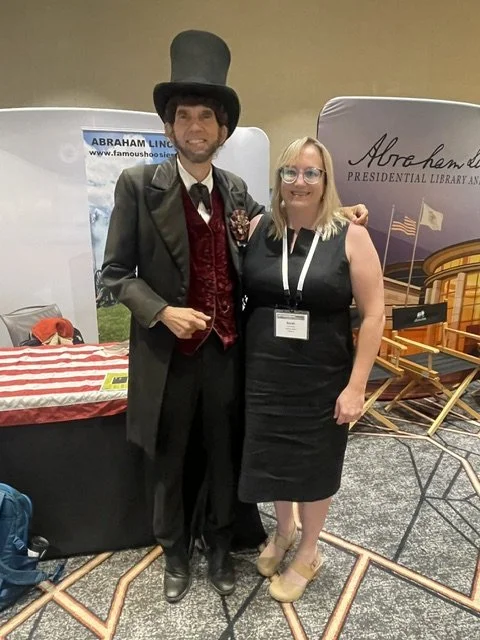
Hello from the Land of Lincoln! Senior Consultant Sarah Owens recently attended the Association of Midwest Museums Conference in Chicago, where nearly 500 museum professionals from eight states gathered to explore this year's theme, We Hold These Truths. As our nation celebrates 250 years since the signing of the Declaration of Independence, AMM used this moment in history to explore what it means to be trustworthy stewards of civil society, our collective histories, shared humanity, and the environment that sustains us. Conference sessions explored the following questions:
What “truths” are we holding steadfast in our work, and which ones are we challenging?
In what ways do these “truths” represent our organizational values and influence our choices?
How are we demonstrating that we have the public’s best interests at heart as keepers of “truths”?
The most powerful takeaways from these sessions touched on all three of these questions:
We hold steadfast to the “truth” that we are stronger together. Build relationships with other museums and cultural organizations. Learn from each other. Start meeting with others in your field several times a year and tour each other’s institutions. Chances are if you are running into an issue, others are facing the same struggle.
We challenged the ”truth” that museums are static institutions that act in a vacuum. A museum’s community relevance and connection does not need to be based solely within a museum’s collection. In actuality, museums and their employees are community builders who live within a larger ecosystem of local government, affiliation groups, neighborhood organizations, clubs with special interests, and other umbrellas our audiences gather under.
A clear example of a museum breaking out beyond its walls to bring their mission to new audiences was a film series created by the German American Heritage Center and Museum of Davenport Iowa. This institution partnered with local government for promotion and an independent theater for a venue, creating a programming series that brings in audiences and community who have not previously been aware of the Heritage Center.
To address the conference’s third question—"how do we demonstrate that we have the public’s best interests at heart”?—the proof is in the engagement. Throughout the conference, we celebrated each other’s successes and milestones reached around attendance and fundraising goals. Examples of museums succeeding to connect with the public were plentiful and celebrated, and stories of growth were shared from many museums—including large expansion efforts from several organizations such as the Nelson Atkins Museum of Art and Springfield Museum of Art.
In addition to taking advantage of America’s 250th anniversary, the conference capitalized on its location with an unconventional kickoff session nodding to Chicago’s history as the birthplace of modern improv. The keynote address kicking off the 3-day in-person portion of the conference leaned into the principles of this decades-old art form and applied them to the mission-driven work of museums. Run by local improv group Malarky Comedy, the keynote kicked off the conference on the right foot with laughter and connection.
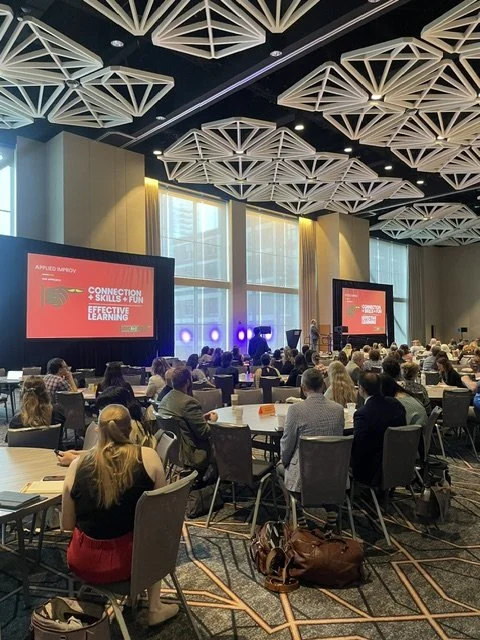
Malarky Comedy in action at AMM 2026
Sarah had the privilege of facilitating a lively conference session alongside educator Zoe Tyler from the Kohl Children’s Museum of Greater Chicago. The session, From Follower to Friend, focused on brainstorming ways to motivate visitors, members, and “followers” to support museum missions more deeply and meaningfully. Together in our session discussion, we explored practical strategies for strengthening existing audience relationships and generating engagement with new audiences. Participants connected with each other and shared examples of how museums can increase their visibility throughout the audience pipeline, with ideas ranging from “dog days” and “dog memberships” at gardens and arboreta to social media contests in partnership with local cultural organizations. It was energizing to hear so many creative approaches to developing an audience pipeline and to see attendees connecting over their own successes and challenges.
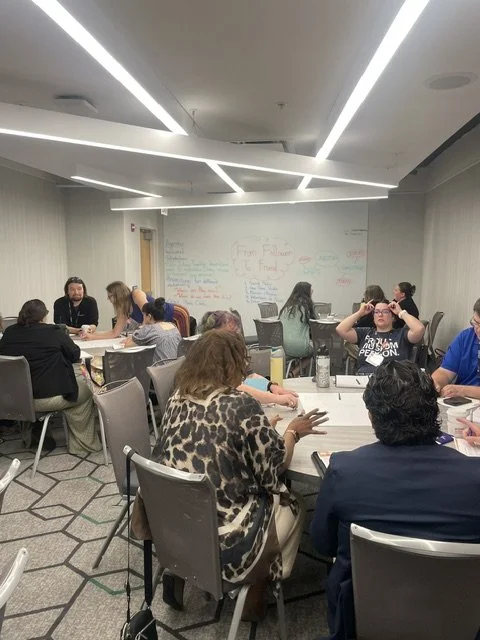
Conference attendees work together at Sarah’s ‘From Followers to Friend’ session
As museums continue to navigate changing attendance patterns, fundraising pressures, and an uncertain future, the willingness of professionals to learn from one another and work together remains one of our field's greatest strengths. We’re grateful to everyone who participated in the From Followers to Friend session and to the Association of Midwest Museums for creating a space where meaningful conversations can lead to practical solutions. We are excited to continue these conversations and help museums expand their reach and build stronger relationships with their audiences—from followers to friends.

The Most Important Question Museums Aren't Asking (But Should Be!)
It All Begins Here
As access to, and understanding of, audience data continues to increase, museums have become very good at understanding their audiences.
We know who visits. We know where they live, how old they are, how often they come, and what they thought of their experience. Many organizations also have years (or even decades!) of visitor surveys, membership data, and website analytics sitting at their fingertips.
And yet, there's one question that still proves surprisingly difficult to answer.
Why does one visitor become a loyal supporter while another, who might look almost identical on paper, quietly disappears?
Most of the information museums collect today is descriptive. It helps us understand what has already happened, but it's less useful for understanding what people are likely to do next. That's where things start to get interesting.
Over the past few years, we've spent a lot of time exploring what lies beneath people's decisions. Not just data that describes who they are, but the deeper motivations that define why they choose to return, become members, and build lasting relationships with museums.
We call these Predictive Motivations®.
Rather than asking, "Who are our visitors?", Predictive Motivations ask a different question: "What are they hoping a relationship with your museum will help them achieve?"
That might sound subtle, but it changes the conversation in important ways.
In our research with art museum audiences, we mapped over 300 distinct motivations that drive visitors to join, renew, upgrade, donate, and visit more often. In fact, we’ve identified that there is a precise mix of motivations (a combination of rational and emotional) that predict each behavior.
Consider this: Our research finds that visitors are excited by the feeling that there's always something new to discover (“Novelty”), and see visiting an art museum as a chance to reward themselves (“Reward”), contribute to their community (“Impact”), and build their personal confidence (“Confidence”). Together, these motivations are powerful predictors of the decision to become a member.
Current membership marketing misses the mark. Let’s fix that!
What's particularly interesting is that these aren't the motivations museums typically talk about in their current messaging or positioning.
Museum marketing often focuses on exhibitions, collections, events, and transactional member benefits. Those things matter, of course. But they're rarely the reason someone decides that your museum deserves a place in their life.
People don't usually build lasting relationships with cultural organizations because of a member discount or an exhibition preview. They do it because the museum helps them become a little more like the person they want to be.
When you begin looking at audience development through the lens of emotional connection, opportunities appear everywhere.
A membership acquisition campaign becomes less about promoting benefits and more about showing people how the museum fits into the life they're trying to build. Programming becomes an opportunity to reinforce feelings of Novelty, Reward, and Confidence, whether that's discovering something new, taking a well-earned break from everyday life, or learning more about a specific art style. Even small decisions about communications, signage, or digital content begin to feel more intentional because they're all contributing to the same goal of building emotional connection by tapping into Predictive Motivations.
Start here.
In our new Playbook series, we outline the complete mix of motivations proven to drive repeat visitation, and increase membership uptake, retention, and giving. Designed to provide your team with data-backed insights, our Playbooks offer actionable tools to embed these motivations and reframe how you engage with your visitors. Our first Playbook, Growing Membership and Revenue with the Science of Emotional Connection, focuses on the Predictive Motivations that drive membership uptake. Sign up here to be the first to get your copy!
Transactional benefits might get someone through the door once, but relevance keeps them coming back. It’s time to stop treating visitor data like a rearview mirror and start using it as a roadmap for building genuine emotional connection.
When we stop thinking only about what visitors do and begin thinking about why they do it, we start making different decisions. Over time, these decisions have the potential to create something much more valuable than just another moderately successful campaign: genuine, lasting loyalty.
Ready to transform how your museum connects with your audiences? Get on the waitlist for our new Playbook: Growing Membership and Revenue with the Science of Emotional Connection to discover the exact mix of motivations to build deeper, more meaningful visitor and member loyalty.

Why Satisfaction Isn’t The Whole Story
Most museums ask visitors some version of the same question at the end of a visit: Did you enjoy your visit?
It’s an important question, and there's good reason the sector has tracked and relied on satisfaction so consistently over the years. Satisfaction ratings (often in the form of Net Promoter Score or “NPS”) help us understand whether exhibitions, programs, and visitor services are meeting expectations and can help shed light on where improvements might be needed.
But there's another question that's becoming increasingly important, particularly in the context of nurturing loyal, meaningful relationships with visitors: Will this person come back?
Those two questions are more different than you’d think.
We've all had experiences we really enjoyed but never repeated such as a wonderful holiday destination, a fun restaurant while visiting a new city, or an interesting museum exhibition. Enjoyment, on its own, doesn't always create an ongoing relationship.
We see this every day in the museum sector: visitors leave enthusiastic and complete surveys with glowing comments and high satisfaction scores, and some even leave a positive review on Google or TripAdvisor. Some go on to become members, donors, and advocates. Others simply move on.
So, if satisfaction can't fully explain that difference between visitors who do or don’t return, is there anything that can?
Our research points to emotional connection as the missing link to building audience loyalty.
Emotional connection is what happens when a museum becomes more than somewhere people visit. When your museum becomes part of how visitors and members see themselves and the life they're trying to create, a switch happens. It's the difference between appreciating an organization and feeling that an organization is genuinely relevant to your life.
This distinction matters because emotionally connected audiences behave differently.
In our latest research, the National Predictive Motivations® Study of art museum visitors, members, and donors, we’ve found that emotional connection predicts substantially higher repeat visitation and a much stronger likelihood of becoming a member. Our research indicates that existing members who feel emotionally connected are also more likely to renew, upgrade their membership, and make additional donations over time. We also know that emotionally connected visitors bring a higher lifetime value to the organization, which can be quantified through our Emotional Connection Score® analysis.
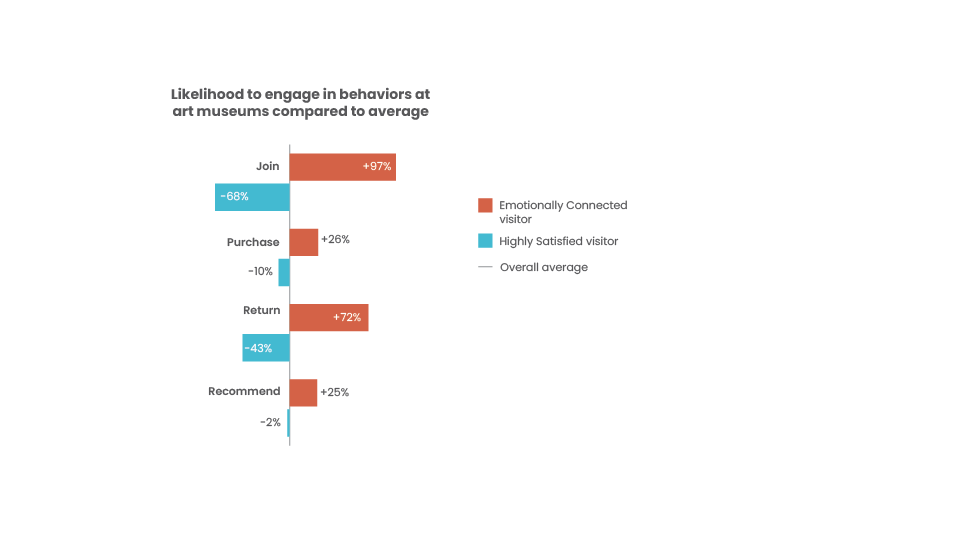
This graph shows how much more likely Emotionally Connected visitors are to join, make a purchase, return or recommend an art museum, compared to the overall average.
Simply put: Emotional connection doesn't simply tell us how people feel. It helps explain what they're likely to do next.
While satisfaction scores are still useful in understanding whether or not museums are delivering experiences that meet or exceed expectations. Let’s broaden the conversation to ask what we could be offering to build more meaningful relationships with our visitors, members, and donors.
This shift has practical implications across your organization. Marketing teams might think differently about the stories they tell. Membership teams might look beyond transactional benefits to consider how membership supports people's aspirations. Education teams might explore opportunities for building emotional connection.
From our research, we now know the exact mix of motivations that spark this emotional connection in visitors, members, and donors.
For museums navigating changing audience expectations, growing competition for people's time, and ongoing pressure to build more sustainable revenue streams, understanding emotional connection offers something particularly valuable: It provides a way to think about audiences not simply as visitors moving through a building, but as people building relationships over time.
Ultimately, emotional connection is what museums are hoping to create: not just successful visits, but long-term relationships in which people choose to come back to, year after year.
Moving from satisfaction to emotional connection:
When we move beyond the rudimentary measure of satisfaction and start nurturing future belonging, we stop merely hosting visits and start building lasting loyalty.
Ready to look beyond NPS? Get on the waitlist for our upcoming Playbook series to learn how to tap into the exact motivations that drive membership uptake.